
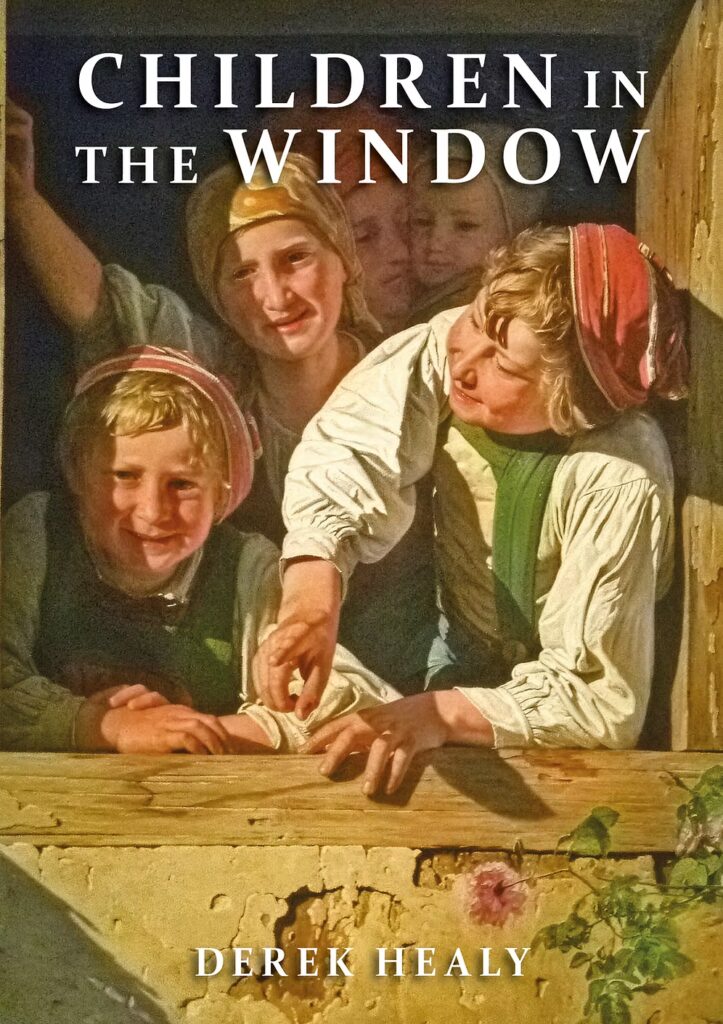
I first came across Derek Healy’s poetry through a reading he did at Cheltenham Poetry Festival. The room was full, the audience appreciative. Healy is one of those poets that event organisers love – his poetry connects with the audience and not just the usual ‘poetry audience’ but a wider one. Even better for the organiser, the audience comes back; Healy has a devoted following. Healy writes honestly and with humanity in a way that speaks easily and profoundly to his audience.
At the heart of the collection is a sequence of sixteen sonnets to the poet’s wife. These ‘Sonnets for a Wife’ epitomise the poet’s adeptness. They are expertly written, but not in a showy way that draws attention to itself. The poet’s use of rhyme and rhythm seems effortless. The focus is instead on the subject matter – a mature marriage. Some poems look back at the relationship’s youth and others look forward to the inevitable parting that anyone of a certain age knows and fears. As Healy writes at the end of ‘Unfinished’, the concluding poem in the collection:
Soon, too soon, there must be a letting go.
In addition to these poems of a relationship’s beginning and ending, the sequence includes other poems celebrating the joy and humour of a relationship where each partner knows the other almost too well and is thankful:
Without you near, would I ever have known
the joy of being together yet alone?
The themes in ‘Sonnets for a Wife’ recur throughout the collection. The act of memory and its communication appear several times, perhaps most notably in ‘A Dream of My Dead Parents’, in which Healy on looking at a photograph of his dead parents in their youth speaks to them:
you’re you yet not quite you, muted by a cloak
of grey, a scratchy duet stuck in time
and I’m your record.
The transience of youth is another such recurrent theme. In ‘Best Days’ the poet describes a reunion with a former college friend after many years:
We meet again
make out young men through furrows and grey.
Their days of youth are depicted as dogs ‘tamed and safely muzzled but from under the table, come growls.’
A sense of time not being a straight line, with the past being more truly beside us runs through the collection, which extends beyond the personal to the historical and the scientific, exploring such subjects as the Big Bang, Neanderthals, Roger Bannister’s sub-four minute mile, and Voyager One. But always there is the poet’s humanity that sits in the centre of this universe.
Healy is not afraid of using humour. In ‘Bookcase Building’, one might expect that the difficulty would be in following the instructions, but the poem recognises that the hardest challenge comes after that – with the decision on what order to put the books on the shelf. A metaphor for so much in life.
This a poet who is not afraid to be present in his poems, but at the same time is not intrusive. He draws us in to his world and in doing so holds up a mirror to our own.
Children In The Window (£7) is published by Graffiti Books and can be found here.
Zoe Brooks is a writer and performer of poetry from Gloucestershire, where she is a director of the Cheltenham Poetry Festival. She has had three collections published, the most recent Something In Nothing was published in 2026 by Indigo Dreams Publishing.