
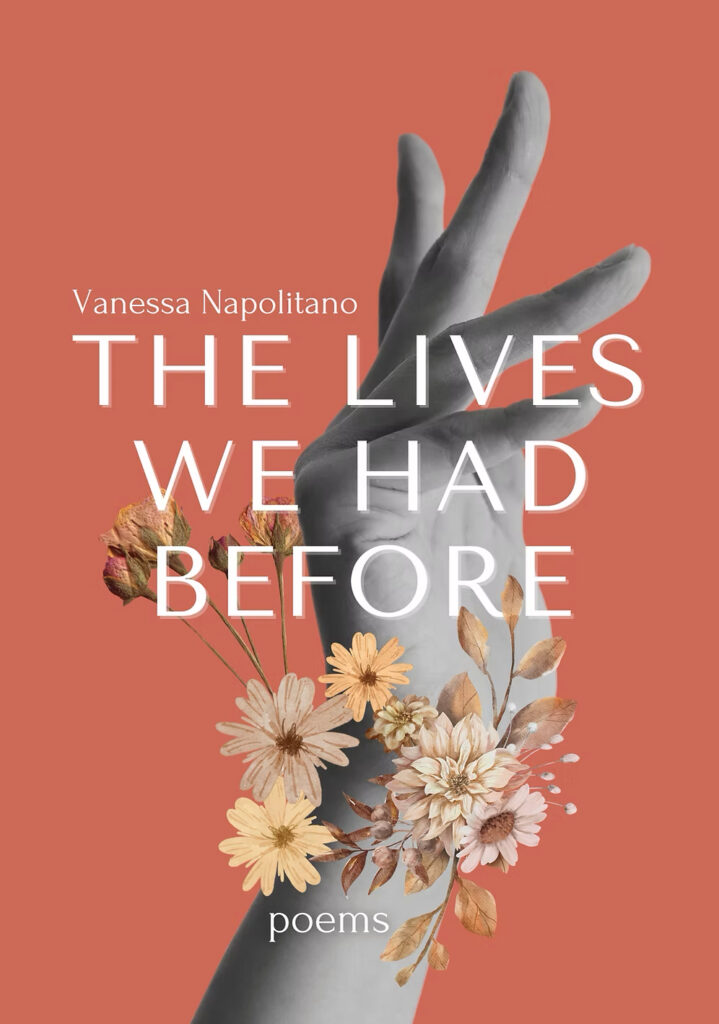
Napolitano navigates girlhood, womanhood, motherhood, grief, and the everyday with remarkable assurance. Each poem in the The Lives We Had Before is a story, an empathy machine, a portal into her rich and vivid imagination.
Napolitano’s writing carries echoes of Lisel Mueller, the German American poet, perhaps because they share the transatlantic experience, one that seems to have given her a distinctive perspective, that catches moments of magic and quickly binds them into words.
In this moving and deeply human collection, memory becomes less an archive than a living thing: restless, porous, and reaching through time. Several poems are centred on the loss of a father and are skilfully written in a way that avoids sentimentality, instead bringing the father back to life, by creating little worlds packed in “ice and salt”, as W. B. Yeats once suggested.
The stoicism of an apple tree, the fading light of the autumn equinox, the vulnerability of girlhood, and the grief of missing one’s father are woven together by a poet who understands what it means to feel deeply, to find myth in the everyday, and to look at the world with wonder. She skilfully transforms these moments into poems that feel, at times, like a tapestry.
In ‘Apple Tree’
When you came back
that wily stoic seemed to say
look what I can do
as if to grow was not all it desired to do
In this poem the ‘leaving’ almost creates the condition for transformation, that sometimes loss leads to you becoming who you were always supposed to be. It also grounds you in nature, the natural cycle of things that are outside of your control.
In ‘I tell my dead father about being 41’
I tell him it isn’t all bad, that these days
I somehow appreciate trees more,
that I care less if people think I am strange.
That I can identify my people from a distance,
that I can make a great martini.
I ask my dead father, who might remember being 41
what he thinks.He says,
It sounds like being alive.
The poem is very effective at conveying the quiet listening that our dead loved ones do. This is not a poem about grief in the conventional sense, instead it becomes a poem about being 41 while speaking across the boundary between life and death. That somehow death is a transition from one place to another. A place we can still reach out to.
Napolitano also does not shy away from the difficulty girls and women often face in their journey from girlhood to womanhood and this is deftly done in the poem ‘A list exercise’.
Laugh at the man who says nice tits wait till you get old enough
for nobody to comment, become somehow enraged when
in a business meeting you get called sweetheart.
Nothing really badever happened to me
just abrasions
to teach me that my body
is a body, is a problem.
The poem tackles the often-contradictory feelings that arise as a result of the male gaze, and it challenges the idea that only spectacular harm counts as harm. The speaker’s body has been continually commented upon, interpreted and diminished, and those tiny encounters accumulate into a knowledge she never asked to acquire: my body is a body, is a problem.
The poem in the context of the wider collection suggests that good and bad experiences coexist rather than cancel each other out; a woman can love and trust some men while being wary or angry because of others.
Napolitano often turns to nature to translate human experience, finding metaphor and anthropomorphic qualities in the natural world. For example, in ‘Your goth garden’:
When my energy seems least, sprouting
a head like a hydra, I will raise up—
a midnight miracle that gallops across
dark land. The
fable will tell of me, of my hidden and velvet country.
Overall, the collection brings you into the interior life of someone ordinary yet extraordinary, capturing the duality and remarkable depth of seemingly ordinary experience.
The Lives We Had Before is published by Stanchion Books in the US and at the time of writing was available on Amazon in the UK.
Satya Bosman is co-editor at Black Cat Press. She has work in 14 Magazine, The London Magazine and The Madrid Review amongst others. She won Third Prize in the Kent & Sussex Poetry Society folio competition in 2025 and in 2026. Her debut collection Dream Logic was published with Crumps Barn Studio in 2026.