
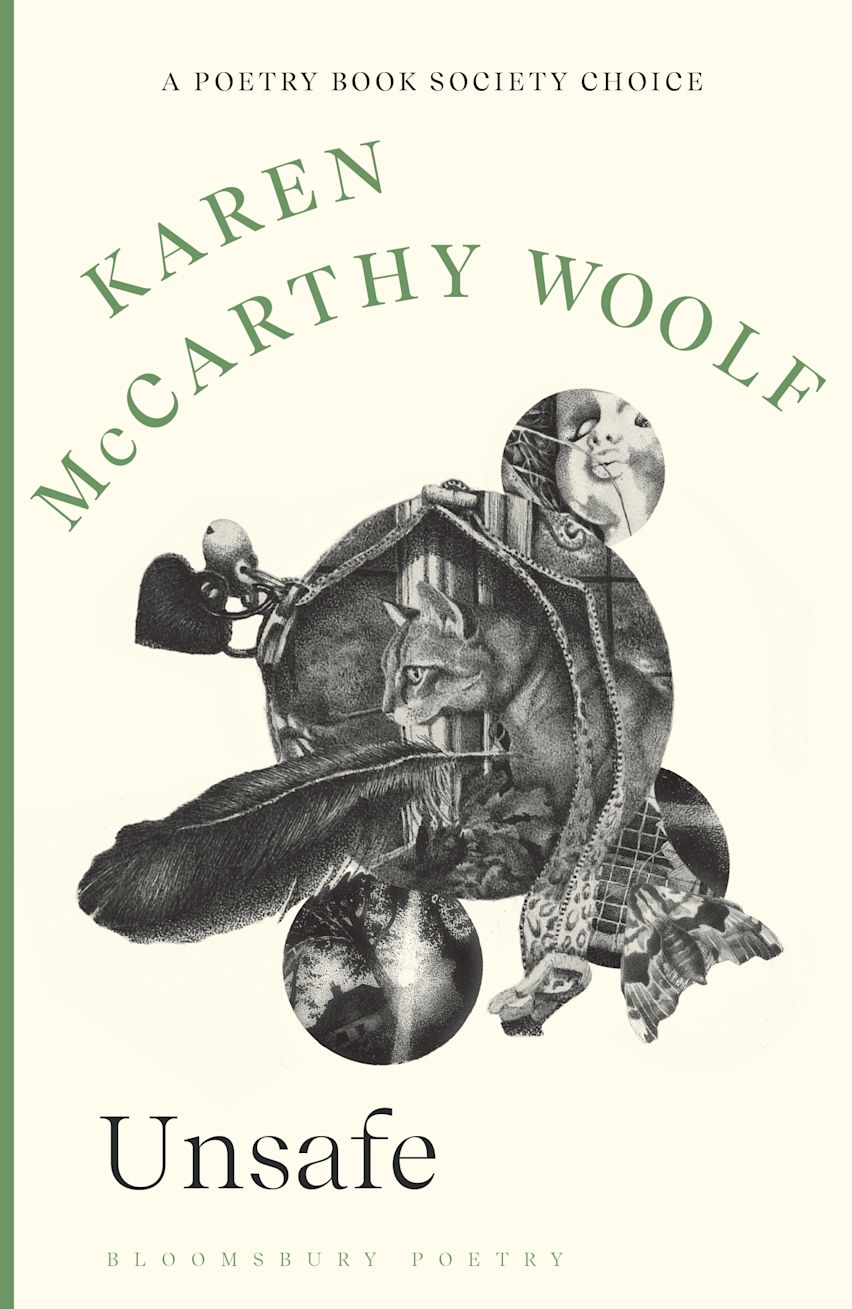
When Karen McCarthy Woolf begins Unsafe with an epigraph from Romantic poet John Clare, the son of a farmer who witnessed the rights to the countryside transfer from common people to private landowners, we are promised a grapple with the enduring legacy of land enclosure and marginalisation.
Unsafe is a book of poetry, not a book of individual poems. It does not consist of discrete and separate poems with their own titles. The ensuing boundarylessness invites the reader to draw connections throughout the work as McCarthy Woolf moves through Britain and America, also visiting Jamaica, Mozambique and Gavdos, always questioning who the land belongs to and who is dispossessed.
Her words are thoughtfully presented. Her lyrics are philosophically dense. Most pages make liberal use of white space, providing pause to digest. Some pages contain only a couplet, or two lines sitting six centimetres apart. Some pages contain short but dense paragraphs, the white space underneath inviting openness in relation to the strict edges of the textbox. The text in these is justified, giving the paragraphs the boxiness of a western American state. The rigidity of form mirrors the content. One textbox recounts an interaction with a police officer who ‘never takes his hand off his gun’ (p.44) on a road trip between Wyoming and Colorado. Another repetitively spends the length of a page ruminating on how the ‘Nazis tattooed inmates’—stopping abruptly mid-sentence. My favourite example lives on page 101. It is a factual, unembellished reporting on ‘The UK’s Criminal // Justice and Public // Order Act of 1994’ which ‘criminalised many // formally civil // camping, gatherings in // fields’. The text is printed twice, in the same spot, but formatted askew so that the decree is almost illegible, provoking reflection on the impenetrable legal theatre in which our rights are constrained.
A visual motif interrupts the work: an asterisk enclosed between the backs of two square brackets like so ]*[. This reoccurring symbol is blown up large and sits in the middle of the page, prompting further reflection on enclosure. Is the * contained by the lyric, or vice versa. On the asterisk she writes, ‘this asterisk was emphatic // & that this asterisk was both legislative and actual and that this // asterisk was intentional and genocidal’. These lines are presented in the context of America’s Homesteading Act, ‘that procedure being the wire as assailant’. Punctuation is interrogated as border, and borders are interrogated as the reader asks what meaning is created when ]*[ interrupts the connective, poetic flow.
These lines are presented across from a photo of cut out pilgrims smiling set amongst the shrubs of an American garden. Striking black and white photographs are interspersed throughout the collection. The whitewashed corner of a public toilet on which a bird is strangely perched, a white van with RAPE spraypainted on its side, the matted hair of a beheaded doll on a grit path. Lines reassuring us it’s ‘OK to be anxious about archival absence’ are illustrated with a coastal horizon, its cloud white sky barely mottled with texture. The interpolation of visual with short fragments of text evokes the compelling rhythm of scrolling through social media. McCarthy Woolf rides this rhythm masterfully. By moving our attention from UK land laws to ‘Driftwood: great lobster claws // of rootlessness’ to the fact that ‘There are no women walking in the woods without a dog’, she draws our attention to disparate parts of a cohesive whole. She is always addressing the question of who owns the land, our bodies, our music.
To answer these questions, tattoos and fences are deployed. But amidst the ‘uncoiled metal’ of ‘garden gate’, ‘security gate’, and ‘anti-climb paint’ weaves ‘underweeded alkanet’. Within her poetry, the unruly natural world exists in opposition to artificially imposed borders. The speaker recounts reading of ‘the inexplicable // and multiple deaths of a dozen ancient baobabs // some older than Christ’. During the same road trip in which they are stopped by the police, they ‘notice the animals, the cattle // are all more tightly penned, squashed together like marshmallows in a packet, though deer still // run at the edge of the fence’. True to the Romantic tradition, McCarthy Woolf pays attention to the landscape, making it unfamiliar and newly beautiful, documenting how it is navigated in our moment of contemporary crisis.
In Unsafe, McCarthy Woolf is successful at continuing in the Romantic tradition. In doing so she resists the mythology of progress. Through poetry, she draws a connection between the emotional, aesthetic logics of the imperialism and industrialisation of yesteryear to our experiences of the world today.
Sairah Ahsan is a researcher and writer who lives on the Welsh coast. Her environment inspires writing about the surreal, thalassic, and queer. You can find her words with Poetry Wales, Extra Teeth, Ink, Sweat & Tears, and M2M books under the alias Rakyah Assam.