
Prose choice
Previous prose
Max Wallis on ‘The Aftershock Review’ for Mental Health Awareness Week
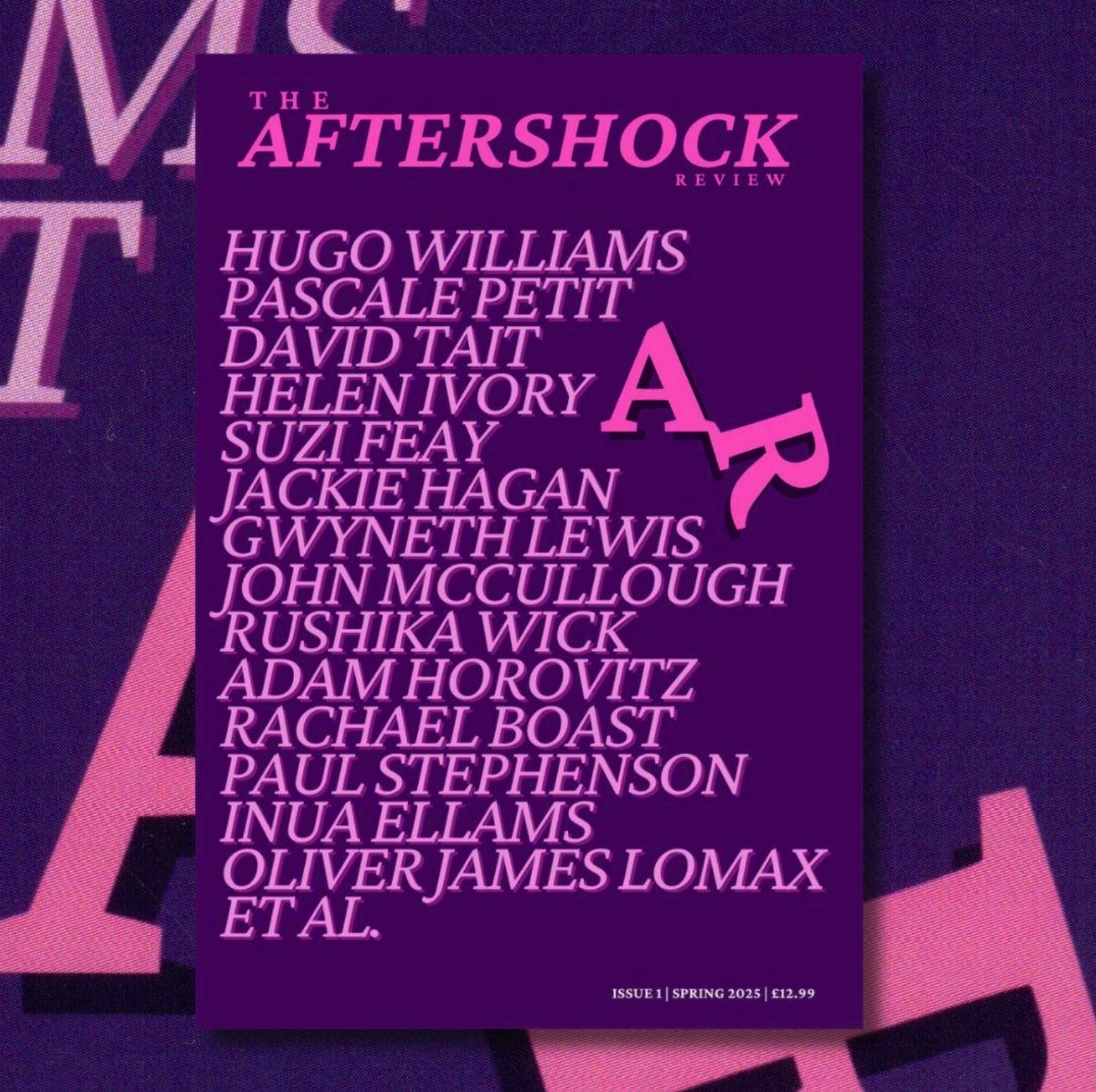
What Happens After the Aftershock?
In February 2024, I took an Uber to a bridge in London. I was planning to die.
Instead, I got out and walked to St Paul’s, where I was detained and sectioned. I remember the shame. The dizziness. I remember thinking I’d already lost everything that mattered: my flat, my mind, my relationship, my future.
Two days later, I fled London with nothing. Not even my sanity to hold me.
Back in Chorley, Lancashire, in the room I grew up in, I lay in bed with PTSD, trying to work out how to stay alive. I was thirty-four, living with my parents, unable to do the simplest things. For a long time, I couldn’t read. I couldn’t cook. I couldn’t bear the sound of my own thoughts.
But slowly, I began to imagine something new. Not a return to who I’d been, but a project that might help me stay. A poetry journal. Something honest. Something that wouldn’t look away. Something I hadn’t yet seen in the world.
I didn’t set out to start The Aftershock Review. I was trying to keep going, hour by hour, imagining a space for work that didn’t feel safe elsewhere. A place for voices I rarely saw platformed, poets who were ill, grieving, disabled, burnt out, or excluded from traditional publishing routes. Could I make something that didn’t demand polish or performance? Could I build something that made people feel less alone?
The first issue of The Aftershock Review features over fifty poets, from emerging writers to major names. Some are publishing for the first time. Others, like IS&T’s own Helen Ivory, Hugo Williams, Pascale Petit, Inua Ellams, Gwyneth Lewis, have long, celebrated careers. But every poem was chosen because it speaks to something true. The urgency of survival, the defiance of showing up, the beauty that can exist after devastation.
The past year has been a reckoning in every sense. It’s also been a revival, and a return to my first and truest love: poetry. I’ve been hospitalised. I’ve been trapped. I’ve lived as an addict and an alcoholic. And I’ve been lucky. I’ve had support. And most of all, love in the form of family I thought I was estranged from and a poetry world that welcomed me back with open arms. As Don Paterson wrote, “Falling and flying are near identical sensations, in all but one final detail.” Poetry helps me remember which one I’m doing.
The Aftershock Review is built around access, care, and community. When our crowdfunder launched, I didn’t expect the outpouring of support we received. That collective belief didn’t just fund the issue, it helped me recover. It reduced my PTSD symptoms, bit by bit. It gave me a sense of purpose again. There’s a strange and beautiful power in being witnessed.
As of March 2025, we have raised £7,124. It also makes possible what we’re planning next: pamphlets, events, outreach, and the long-term goal of The Aftershock Society, a press for poetry that we hope will reshape the literary landscape entirely.
We believe trauma speaks many languages. It whispers in the quiet of a bruised room, echoes in waiting rooms and hospital corridors, and lingers in the smallest details: a Tupperware box, trying to find a pin in a sharps box in the hospital to change your sim card, a laugh that arrives like a bear hug. Poetry lets us hold all of that, not to solve it, but to name it, sit beside it, and sometimes, transform it.
In The Aftershock Review, we’ve published poems that move through grief, illness, psych wards, addiction, love, loss, and laughter. Joseph Fasano reminds us, “The amount of agony / you carry / is only the vastness of your / love / waiting in the darkness to be found.”
There are wounds that don’t fully heal, and some that reopen again and again. But I believe we can still write from them, not despite the damage, but because of it. Through poetry, we find other ways to breathe. Other ways to keep going.
Mental health is not separate from this work. It is threaded through every page. This magazine wasn’t made in spite of illness. It was made from it, with care, with attention, with time.
This is The Aftershock Review, a journal built in the aftermath. A home for poems written when everything else was falling away. A place to say: you are not alone in this. You never were.
Max Wallis is the editor of The Aftershock Review which launched this spring. To buy, to submit to, to contribute to the crowdfunder, please click here: https://www.aftershockreview.com/
Harlan Yarbrough
An Orphan’s Progress Geoffroy, no longer young and a man of importance, could have ridden in a luxurious coach. He chose to walk, because he enjoyed walking. If Zarafa was going to walk he would walk with her. No strolling,...
Michael Forester for National Flash Fiction Day
Fallen Hero First furloughed, then declared redundant by the Justice League, he is asked to hand back his cape and boots. His instinct is to seek immediate solace in the Fortress of Solitude, but it has floated away on a rising tide of...
Meg Pokrass
The Forest This has something to do with the adoption of that unwanted animal, right there in the living room. Her husband watching telly, drinking beer, not looking at the animal dancing around. The animal gazing into her eyes, finding her...
Kate Rigby
You’ve got a pop belly, mama. Like when you had that baby. It’s a pot belly, she said. And there was no baby. I thought it was pop, because babies just pop out. She didn’t say any more, though when I was very little she said I popped out like a...
Sufia Hayat
The List In The Brain This was a special day, Rabia knew it. She had to wake at least an hour earlier than usual. It was special for her too, because today, Saleema had promised to give her salary along with arrears. She gulped lukewarm...
Charlie Hill
Pulling together Yasmin and Josef lived on Laburnum Avenue, an unremarkable suburban street where the bins were emptied on time. Yasmin and Josef felt at home but when the form from the Be a Better Neighbour! campaign arrived, Yasmin didn’t quite...
Michael Bloor
The Ominous Sweetie-Jar Ever since he was 17, Angus had been saving the tiny hairs shaved from his chin by a succession of electric razors. Now, aged 67, he had one of those old-fashioned, large, glass, sweetie-jars almost full of his own tiny...
Rachel Wild
Zina I remember your laugh, a cackle, irrepressible and sometimes never ending, echoing down the stairs. Wooden stairs, or were they covered in lino, scuffed by hundreds of feet up and down in that damaged old house. There were eight of us living...
Luke Lewin Davies
Stefan We did foster care. We took in this kid. He was eight and his name was Stefan. His dad had recently died, his mum had severe mental health issues. There was a step-dad, we were told. But he belonged to us, for now. We met Stefan a couple of...