
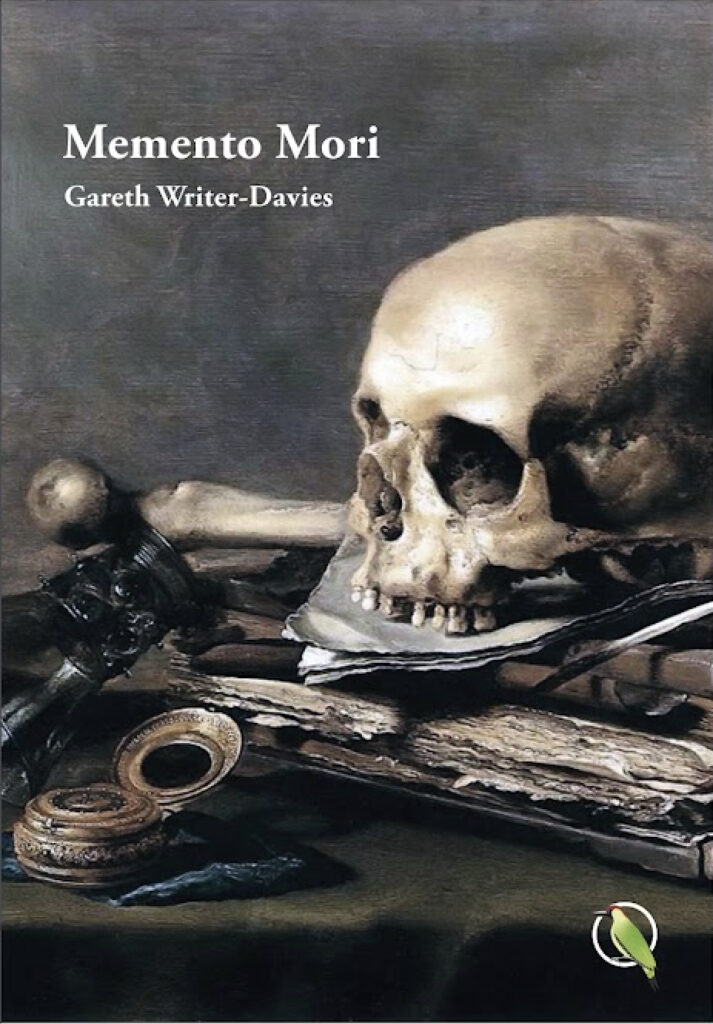
With a collection titled Memento Mori, you’d expect poems that dwell solemnly on death. Gareth Writer-Davies certainly keeps mortality in view, but this collection is distinguished by its insistence that death is encountered, not as an abstraction, but through the accumulated textures of ordinary living: worn kitchen appliances, inherited tools, overgrown gardens, family photographs, cats, freezers, roses and sheds. These are poems that understand memory as something stubbornly material. As the speaker writes in ‘Remnants’, ‘I have not forgotten you’, a simple declaration that becomes the ethical centre of the collection. This is a collection less preoccupied with endings than what survives them.
There is something of the emotional candour of Philip Larkin in the refusal of consolation and in the way domestic detail becomes charged with existential significance, but where Larkin often arrives at emotional paralysis, these poems remain animated by curiosity and acts of repair. Elsewhere, one hears something of Seamus Heaney’s instinct for allowing objects to carry emotional and historical weight. Yet Writer-Davies’ voice is unmistakably his own: conversational, self-deprecating, intellectually alert, capable of moving from humour to profound unease within a few lines. From: ‘We must remember how we were beguiled’:
One shouldn’t despise one’s partner
her luck, as she takes off her tights
and wobbles in warm, forgiving waters.
I once stubbed my toe on subterranean
wreckage, as I was paddling and made small
children cry as I stomped around cursing.
I apologised and felt terrible after:
still keeps me awake at night, locked in amber.
The collection is carefully structured around recurring motifs that gradually accumulate symbolic force. The freezer appears in several poems, no longer only an appliance but an archive of grief, preservation and deferred reckoning. Inherited possessions – a Kenwood Chef, a shotgun, a cowboy shirt, a rose planted in memory – refuse to remain merely functional objects. They become repositories of identity, carrying emotional residue long after their original owners have disappeared. The image of ‘crumbs and thread’ in ‘Three glazed biscuits and a needle and thread’ perfectly encapsulates this in-stinct to preserve what can be repaired.
Family provides the emotional centre of the collection. The portraits of both parents resist sentimen-tality, presenting love and resentment, admiration and disappointment, in uneasy but necessary coexistence. Writer-Davies avoids the temptation to simplify familial relationships into narratives of reconciliation. Instead, memory remains morally untidy, its ambiguities preserved rather than resolved whilst language remains lucid, allowing emotional complexity to emerge through observation rather than rhetorical flourish. In ‘Most determined daughter’:
we have been stirring the paint for some time
now we have the shade
Pink Moon
whitewash darkened with a little blood
One of the pleasures of the book lies in its restless range of reference. Edward Said sits comfortably alongside Berlioz; Greek myth appears beside suburban Wales; Dickens, Puccini, opera, fairy tales, museums and gardening manuals all bubble through without self-conscious display. These mirror the workings of memory itself, where high culture and popular culture occupy the same mental landscape.
Men here are fathers, sons, teachers, lovers and survivors, often struggling beneath inherited models of stoicism that have ceased to function. Rather than offering polemic, Writer-Davies explores these tensions through anecdote and image. A suit of armour becomes both historical artefact and metaphor for emotional self-protection.
Although grief forms one of the collection’s principal concerns, it’s frequently funny. There’s wit in the speaker’s self-mockery, the absurdity of domestic life, the affectionate observations of cats and neighbours, and the recognition that even profound philosophical reflection may be interrupted by the practical business of gardening or making soup.’Most of life must be lived thin, / spread with occa-sional butter’ shows Writer-Davies’ gift for balancing wit against grief without diminishing either, and prevents the collection from becoming oppressive. Indeed, one of Writer-Davies’ most appealing qualities is his willingness to allow bathos and dignity to occupy the same poem, as in ‘Now it’s been two years’:
We made you mute (sorry about that)
but I’ve left the window open a crack.
Take a deep breath of dust.
emanate.
I have a fine mesh net in one hand
and a Hoover in the other.
The poems are equally varied. Alongside tightly controlled lyrics appear longer meditative pieces, list poems, repeated refrains and more experimental visual arrangements. The free verse rarely calls attention to itself; instead it follows the rhythms of thought, allowing syntax to dictate movement rather than inherited metrical patterns. This conversational ease can appear deceptively simple. Closer reading reveals carefully judged pacing, subtle repetitions and images that continue resonating long after the poem has ended.
Perhaps the collection’s greatest achievement is its refusal to sentimentalise either life or death. Memory is neither static nor sacred. Writer-Davies repeatedly reminds us that ‘the sea slips stoically away’, an image whose quiet acceptance feels emblematic. It leaks, fades, returns unexpectedly, occasionally betrays us. Yet it remains our most durable means of resisting oblivion. This collection reminds us that remembering is never a passive act, but an ongoing labour, undertaken with joy.
Memento Mori (£14) is available from Yaffle Press.
Melissa Todd is a writer and performer who contributes regularly to Metro newspaper and Kent Online. Her sharp, irreverent work explores sex, ageing and society. She is the author of Gag Writer and creator of the acclaimed one woman comedy show of the same name.