
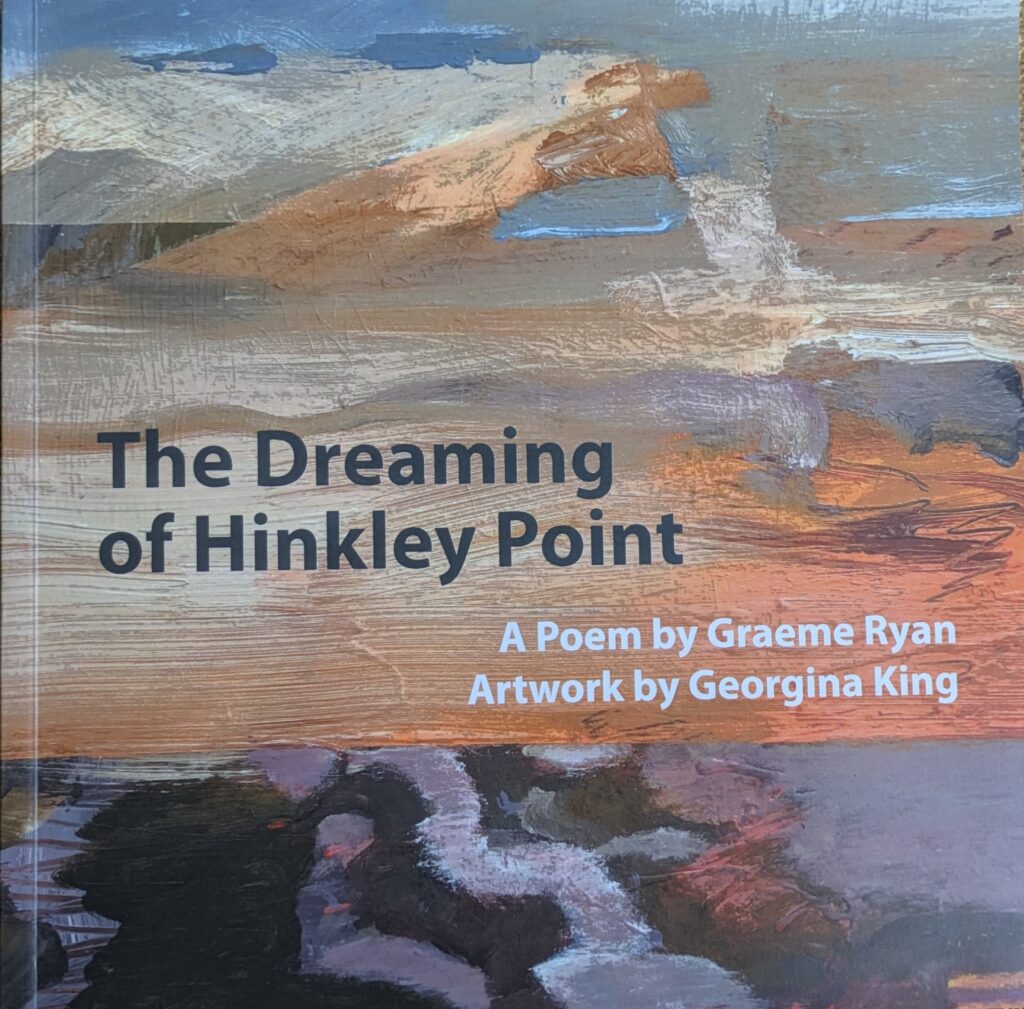
A poem by Graeme Ryan
Artwork by Georgina King
This is such a generous book – the very first things the reader notices are its large square size, and its glowing colours. There is a palpable sense of successful collaboration between poet and artist going on here.
The Dreaming of Hinkley Point is based on the notion that if Samuel Taylor Coleridge were able to stand atop the Quantock combes in 1797 and look east to see the nuclear power stations of Hinkley Point – what would he make of them?
The book begins with Coleridge in his idealistic years, in which he understands the power of Hinkley as a generator of the Divine Imagination, a place where human original sin is recycled and transformed, a union of science and religion.
Coleridge, alongside his 21st century avatar (Sam) who’s just landed a job at Hinkley as a software engineer, is thrilled. At first.
Each page holds both beautiful, light-lit images created by Georgina King, and poetry. The book is a kind of narrative of Coleridge’s (and our own) developing understanding. It’s very ambitious, as Ryan draws us into this locality, these two contrasting times, with skilful poems that like the artwork, resonate with colour and imagery.
I hear the redstart wind and unwind
the green pulley of Spring:
genie dabbing his orange flame
Coleridge’s unselfconscious closeness to the natural world is expressed in gesture and local placenames:
kneel to wash my face in the dew
of Hare Knap, Alfoxton,
Lady’s Edge
In ‘Sam’s Interview for Software Engineer’ Coleridge’s 21th century avatar speaks, saying he wants –
to believe in the suit of the man
the shirt he is wearing the mathematics
in his head the silver flight case its click
and the complete lack of punctuation evokes both stream of consciousness interior thought and also interview nerves. But he gets the job.
Just a little later, in ‘Sam opens the Power Station Brochure’ we perceive the 230 year gap:
Leave your fallen world
and doubts behind.
‘Meet this shining city on a plain:
a cyclotron to break things up,
accelerate and reconfigure the world…
I send peace not a sword’
gleams the atom.
The use of technical language within this (and other) clever poems lends them appropriate scientific credentials; but the use of ‘gleams’ as the atom speaks, feels laden with a warning that 21th century Sam might recognise more rapidly than Coleridge.
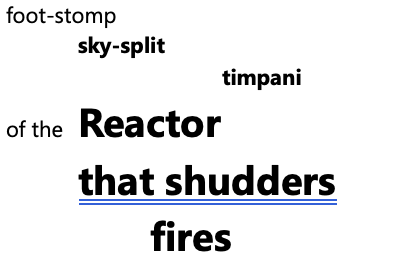
And then the artwork is on fire in reds and oranges, and the poem breaks from stanzas into free-form, even the font size lurches bigger and bolder –
Towards the middle of the book comes ‘Perceptions: Dorothy and Sam/Walton, Cockcroft and Rutherford’ in which the scientists’ observations of, for example, ‘alpha particles’ are laid alongside the poets’ observations of the natural world they are walking through. This strange and displacing poem ends –
As a result, they had also confirmed
Einstein’s equation nature never did betray the heart that loved her.
This poem is accompanied by the only photographs in the book (titled Encounters, O’Sullivan, 2006), which lay down another layer of art and observation, showing us: ‘sentry in the marshes’; and ‘a washed-up mermaid’.
In ‘Sam and Dorothy enter Chernobyl’, the narrative darkens. Our protagonists creep past the guards. But –
they catch us and we are torn apart.
When I demand to see her
they isolate me on the ward…
the Russian word for wormwood is Chernobyl.
The book has a bright spiritual vein that runs through it, charged by the landscape, by the abuse it suffers, and by its still-remaining glories. The poems lie in fierce opposition, so ‘Sam Reaches Out to the Divine Once More’ –
I will wake to the abbey
and pleasure-domes again…
the wryneck quee quee quee
cuckoo with his notes older than England
is followed immediately by ‘Prayer’, in which –
the cranes the tallest cranes strut and cantilever over
the technopolis the radioactive city policed by Geiger
the termites in hard hats
probing calculating testing grasping
their dominion
The Dreaming of Hinkley Point concludes with thoughtful reflection. ‘In the Nature of a Psalm’, Ryan invites the reader to
Walk the forest paths of Hinkley again with me
listen to nightingales and golden orioles…
sparks
of the
poets
particles
of the
physicists –
…an
atom
split
tock
into
two
from
the One
Readers who reflect on how we live in England today, and who are aware of historic contrasts with other times will be fascinated by this ecologically sensitive, inventive and beautiful collection.
ISBN 978-1-0369-1784-5
Jynx Books (2025)
Available at georginakingart.com
Jean Atkin’s third full collection High Nowhere is was published in November 2023 by IDP. Previous publications include How Time is in Fields (IDP); The Bicycles of Ice and Salt (IDP) and Fan-peckled (Fair Acre Press). She is a poet in education and community. www.jeanatkin.com