
A very striking and thought provoking piece of work.
An evocative poem, powerful, visceral; a poem striking in its metaphors and nuances, with a strong sense of place – Plymouth and its Barbican area – and both past and present. (Two days after the poem was submitted to us an unexploded bomb was discovered on a building site in the Millbay area of Plymouth with another further afield in Exmouth.) But most striking was the sense of vulnerability to those ‘nucleated red blood cells’, a ticking time bomb and for these reasons and more ‘Unexploded Bombs’ by Samantha Carr is the IS&T Pick of the Month for January 2026.
Samantha Carr is based in Plymouth, UK, where she is a PhD Creative Writing candidate exploring the lived experience of chronic illness and the healthcare system through prose poetry. She also formerly worked in the NHS as a nurse. Her work has been published in several places, including Arc, Acumen, Ink Sweat & Tears, Mslexia and Room. In her spare time, she enjoys experimenting with surrealist art. She can be found on Instagram @samc4_rr, and on Facebook @samantha.carr.9275.
She asked that her £25 ‘prize’ be donated to World Central Kitchen.
Unexploded Bombs
You became obsessed with nucleated red blood cells when you peeked through an
aperture window at your liquid, viscous nature. You became obsessed with maps
after an unexploded bomb exposed a Second World War timeline fault sleeping in a
garden in your city. Several results on the pathology printout are marked with carets.
The Bomb Book marks the location of dropped devices with sticky red dots.
You don’t have a garden, so you revert to the sanctuary of one of the few places to
survive the Blitz, the cobblestones of the historic Barbican. These are pebbles and
sandstones taken from the riverbed. Edges eroded by centuries of foot traffic, horse-
drawn carriages and even the advent of the modern car, something it was never
designed to sustain. Outside the Admiral MacBride, these stones have
been puked on, fought on, slept on, bled on. How many memories remain in
the sand or have been washed away with the Mayflower Steps and castle
fortifications to rest on Sutton Pool’s harbour floor? Are nucleated red blood cells
dangerous? The GP says it’s not something we normally look at. The internet
says they’re rarely present in healthy adults. The Pathologist says the results should
have been suppressed. You paste your discoveries into the Bomb Book.
Other voters’ comments included:
I liked all the subtle nuances linking an abnormal blood results report to different places in Plymouth and their associated battles, the link to unexploded bombs in Plymouth to the exploded bombs hiding within these blood results that are being palmed off by the GP was so stark and hard-hitting.
I love the visceral language and blending of ideas.
I enjoyed its terse and violent nature, reflecting the tension that surrounds an unexploded bomb.
I love her style and depth.
It’s really evocative.
Very cleverly written especially following events in our city recently!
Evocative and beautifully written
The imagery is great. It really resonates with me.
Because it was very powerful and resonated with me
Very well written and catches the real life of living in Plymouth
Really made me think.
I liked all the subtle nuances linking an abnormal blood results report to different places in Plymouth and their associated battles, the link to unexploded bombs in Plymouth to the exploded bombs hiding within these blood results that are being palmed off by the GP was so stark and hard-hitting.
I like the metaphor the poet has used.
Powerful and expressive
I enjoyed how this reflected Plymouth’s landmarks (I’m from Plymouth) but also medical anxiety (which is a common theme in my life). Unsettling.
As a local this poem spoke to me and made me see the barbican in a whole new light.
I particularly like the metaphors comparing blood and uncertainty in the city with the same in the patient narrating the piece.
THE REST OF THE JANUARY 2026 PICK OF THE MONTH SHORTLIST
Window of tolerance
we’re trying to construct a frame for this
highly reactive impulsive emotion
the nurse is looking into it meanwhile
we must find something cold to hold lick it
we’re trying to expand the tolerance – think
of a moth thumping at the window imagine
a pane adjustable along the diagnosis
for excessive information’s tiny racing heart
to be processed a bullseye window pivoted
on the horizontal with cunning joints
at either end allowing it to open let it fly
it’s a lovely day if you like lovely days
Helen Akers lives in North Norfolk. She is working on a collection of poems which explore the experience of bipolar disorder from the carers’ perspective. She has an MA in Creative Writing from the University of East Anglia.
*
Plainsong
Have you heard the one about
how I’m hoping to bow out –
playing guitar for the Cure
on a wide stage – the riff pure
as wind-bells in the twilight,
the crowd stretching beyond sight
into the dark and the rain –
smiling, not ageing, not in pain,
lost in the longing song, doubt
done with, drowning myself out?
Antony Dunn has published four collections of poems most recently, Bugs (Carcanet OxfordPoets) and Take This One to Bed (Valley Press). Winner of the Newdigate Prize and an Eric Gregory Award, he edited and introduced Ex Libris, a posthumous collection of poems by David Hughes (Valley Press). Antony is a regular tutor for The Poetry School and has taught many times for Arvon. He has worked on a number of translation projects with poets from Holland, Hungary, Israel and China. He has been Poet in Residence at Ilkley Literature Festival, the University of York and the People Powered Press. Until 2018 he was Artistic Director of the Bridlington Poetry Festival. Antony lives in Leeds. Website: antonydunn.org
*
Cloud
Forget the invisible network of servers which stores
and manages or mismanages data in the unending sky
far above our heads, and ignore the shroud-grey layers
louring today – they seem to have sucked all the colour
out of this world which struggles every day to cope
with disasters. Slow down and try to immerse yourself
in the whiteness above the distant rows of houses,
spread your arms and let them rise above your head.
Think of them as dancing clouds and lightness will fill you,
ease your aching body. On evenings when scarlet
floods inky layers of sky, watch the incandescent globe
above the viaduct in the park as it sinks into darkness.
Now imagine clouds sucking in water vapour until heavy
as milky udders, they release rain that cleanses the air
and seeps into the over-dry ground beneath it.
The moisture will soften clods, feed worms, sticklebacks,
beetles, all the creatures living below the surface.
Go into your drenched garden, breathe in the sweet air
and think of Wordsworth wandering lonely as a cloud
through field after sodden field. Then close your eyes,
picture the moment he caught sight of the daffodils.
Myra Schneider’s most recent collection is Believing in the Planet, (Poetry Space 2024). Her other publications include fiction for children and teenagers, books about personal writing, in particular Writing My Way Through Cancer and Writing Your Self (with John Killick). She has had 14 full collections of poetry published and her work has been broadcast on Radio BBC4 and BBC3. She was consultant to the Second Light Network for women poets during its 25 years and frequently wrote reviews for its magazine Artemis. An in-depth interview about her poetry and books appeared in Acumen in September (2025). Her work has been widely published in printed and online poetry magazines, also occasionally in newspapers. She has finalized a new collection ‘The Disappearing’ which is due late in 2026 from Poetry Space. She has co-edited anthologies of poetry by women poets and she has been a poetry tutor for many years.
Note: Dancing clouds is a Tai Chi/Gigong exercise
*
take this
I see
how you see
us in meetings:
merchandise
to slip
off
the shelf.
Your eyes on the cameras
overhead
as
you turn
sideways
to hide
pilfering
your deposits into
your many pockets.
Monday, Henderson talked about
how to energize our sales team
providing sparkler specifics that you then waved
in front of the VP
leaving Henderson
with unlighted, unused punks.
Tuesday you stole from Kaufmann
as you sidled up on the left:
A clean lift. It was yours now.
Seems you have hollow
space, a filing cabinet
where a conscience should be;
you need the voltage
of other people’s thoughts
to keep the lights on.
Wednesday it was Carol’s property:
no yapping dogs to slow you up,
no electric fence, no motion detectors.
Today you took Rajesh’s half idea
and got the other half from Lance;
you took the mashup to our director
with none the wiser except me.
So tomorrow is my turn:
shadow becomes shill:
I will draw you in with an irresistible idea
floating,
gently,
up from the
middle of the
conference table
next to where
the speaker phone sits.
And you will take it —
not the speaker phone —
the trap —
without a second thought —
that extra effort required
to protect you from the dual-edge.
You will present it to the board next Tuesday,
and buried
in the subtext,
will be the hint
of exposure of
the skilled
juggling
acts of our VP
who
between going to jail
and setting you up
to take the fall
has an easy choice to make.
I won’t be there to watch.
I will be taking the day off.
Something I sometimes do
when I wish to spend
some quality time with your wife.
Zumwalt‘s poetry explores themes of alienation, shifting reality, and personal adaptation. You can find additional Zumwalt poems at zumpoems.com
&
Jessica Mookherjee reviews Grey Time by Julia Webb
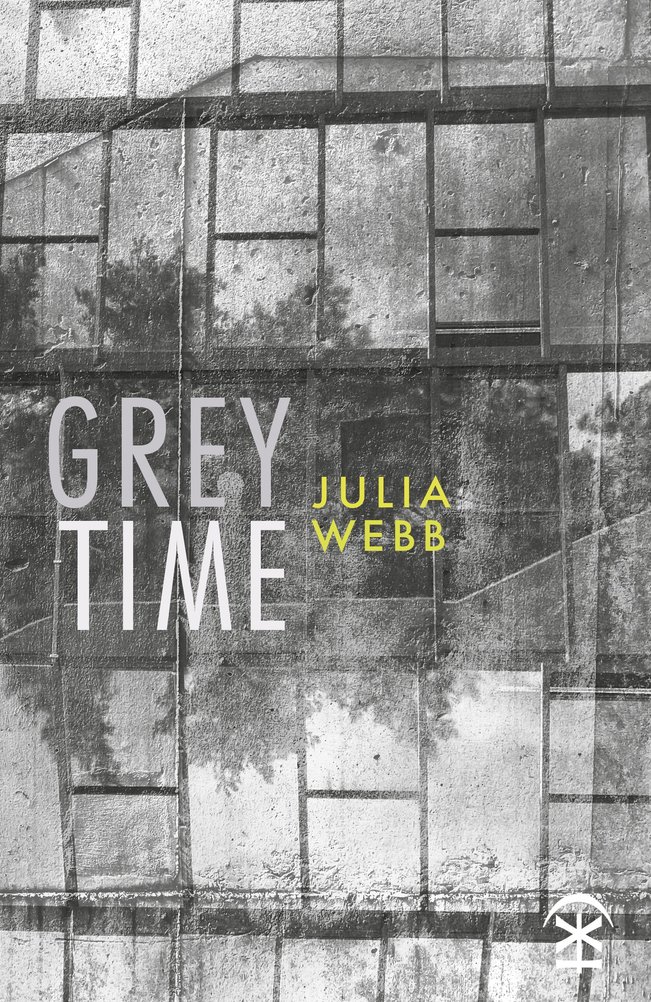
Julia Webb’s Grey Time, her fourth collection with Nine Arches Press, insists on the full weather of grief. It refuses consolation or tidy acceptance, tracing the recursive ways mourning inhabits a life — memory, dream, body, animal.
From the opening pages, Webb stages grief as ritual and repetition. Each day the speaker climbs the exposed tower of loss, pausing for breath at the midway point, aware of the groove grief has carved — and of the dangerous wish to dismantle it altogether.
The shape of grief
Grief in Grey Time becomes architecture, map, creature, weather. In “A Geography of the Dead,” burial grounds sit close to the roar of traffic: mourning unfolds while the world goes on. In “The Hare,” the totem animal becomes omen, memory, guilt — never explained, allowed to remain strange. These are metaphors that work, not decorate.
The title poem, “Grey Time,” is the collection’s hard core. Hospitals, buffets, paperwork, piss-stained sheets, refrigerated lorries: Webb resists elegiac polish, holding love, irritation, exhaustion and tenderness together in a finely shaped prose sequence. Its moral clarity lies in refusing to simplify.
Mother as enchanted wound
Webb’s portraits of the mother are complex and heartbreaking. “For I Will Consider My Mother” praises — Who stained the world purple and covered it with glitter — enlarging her into myth. Elsewhere the mother is enmeshing, consuming. In “The Same Mother,” the daughter is taught to be a house, not a tree, while the roots spread deeper into your foundations. Love and constraint are inseparable.
Elegy does not erase harm. Webb honours that contradiction.
Childhood, trauma & ghosts
Some of the most affecting poems return to childhood with devastating simplicity. In “A Small Girl Cries on a Blue and Black Tiled Kitchen Floor,” snow fills the kitchen until the mother disappears. It doesn’t describe trauma; it enacts it. “Trying to Make Sense of Things” watches a child find unconditional love only to lose it, perhaps still in the hallway waiting.
Ghosts recur as psychic residue. “The Magic Ritual” confronts survivorhood: the speaker, stunned by morning news, walks as though partly dead.
The quieter violences
Webb makes visible harms that leave no bruises. In “If Only You Didn’t Have to Shove Your Living in My Face,” the beloved wants the speaker smaller, quieter. She folds herself into corners until even her shadow is too much — and then breath becomes resistance: I sucked in as much air as I could.
Mothering as a different animal
Turning to her own motherhood, the register shifts — not to sentimentality but to a new animal knowledge. “More bird than woman,” she listens, learns the child’s weather, offers him the cosmos and then relinquishes it. A kind of repair, without pretending redemption.
The relentlessness of grief
Losses keep arriving. In “After My Brother Died, I Let My Garden Get Overgrown,” guilt and beauty coexist: tears, sunlight, an unruly garden. In “If,” syntax fractures into the grammar of regret — if I wasn’t / I would’ve fought — until language meets the blunt fact of the headstone. Grief has seasons — and they return.
The owl in the dark
The closing poem, “Without,” is an unguarded act of making. I am building you an owl, the speaker writes — waiting for your breath to knock it down. After, the wish — I wish you back from the dead — comes a gentler gift: acres of owl flight… the smells of the woods. Darkness becomes path, knowledge, companionship.
Where much British writing about mourning leans to restraint, Grey Time risks imaginative ferocity. It is unsentimental and deeply humane: a book that understands how love and damage endure together, and how language, even when it fails, may be all that remains.
Grey Time does not console. It stays. And that feels like truth.
Jessica Mookherjee is a British poet of Bengali heritage. She is author of three full collections and three poetry pamphlets. She was twice highly commended for best single poem in the Forward Prize 2017 and 2021. Her second collection Tigress (Nine Arches Press) was shortlisted for the Ledbury Munte Prize in 2021. Her most recent full collection is Notes from a Shipwreck (Nine Arches Press 2022). In 2023 she also published a long London prose poem Desire Lines – with Broken Sleep Books. She is a tutor for Arvon.
Grey Time by Julia Webb is published by Nine Arches Press (2025): ninearchespress.com