
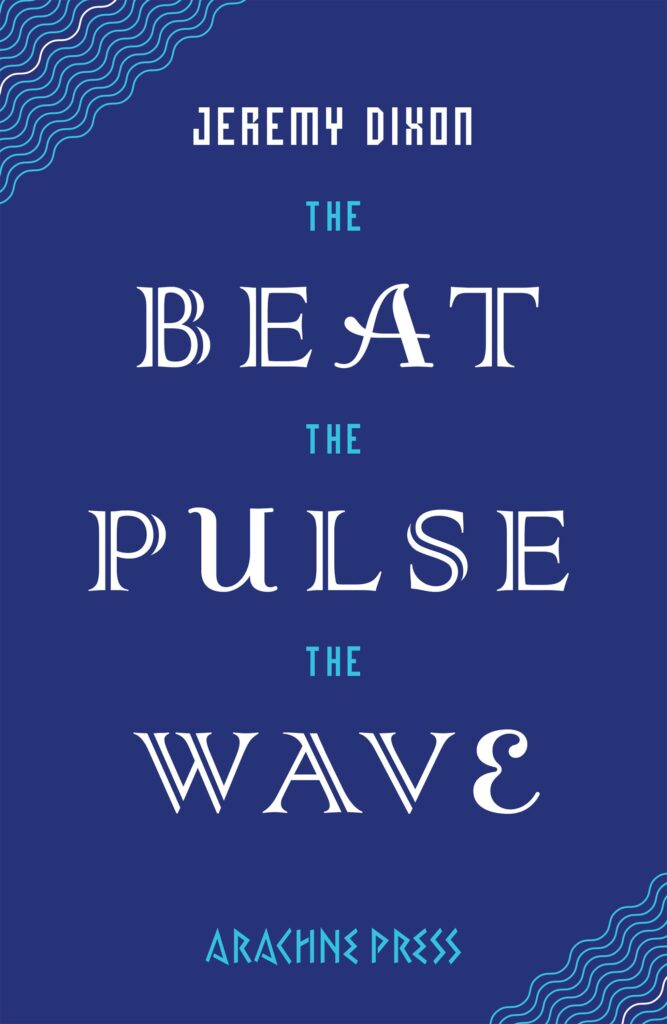
The Beat The Pulse The Wave appropriately has a pulsing energy to it, like waves crashing on a shore. Jeremy Dixon writes about life, past, present with hints at a future; it feels that each poem pins down an everyday experience but offers a slantwise look at it. Readers can be carried with the tide or can pause and marvel at the crystalline details in the sunlight on the breaking waves. Its scope includes Sir Gawain, Egyptian artefacts, 80s’ music, King Canute, teenage embarrassment and family members.
‘dent in the bonnet’ at face value is about listening to Kate Bush’s album The Dreaming over and over again on the day the poem’s speaker died.
the 2018 remastered edition
on premium 180 gram
heavyweight vinylthe most experimental
divisive album of her career
a cacophonyeach track
an act
a changingsat in your lap
get out of my house
suspended in gaffa
The italicised lines at the end of the poem are titles of tracks from the album. But there are hints this is also about the poem speaker’s relationship with his father. That a death is a chance to remaster or revisit that relationship, perhaps allow the adult child to reclaim and revoice that relationship according to his own point of view instead of deferring to a father. The details regarding the weight of the record, that the relationship was ‘experimental’ and ‘divisive’ suggests rough patches as his father was trying to be a parent, a role that never comes with an instruction book. The poem follows how each stage of the son’s growing up forced a change in his relationship with his father. From a toddler sitting in his father’s lap to a teenaged son being told by the father to ‘get out of my house’.
The relationship disintegrates, ending ‘suspended in gaffa’ so it seems as if the blood tie was the only link that kept the two in touch. The poem doesn’t clarify whether the choice of album was a deliberate choice by the son or a subconscious choice that prompted the selection of that particular record. The repeated playing implies a need to sit with the choice and think about both songs and father.
‘WARNING’ has the feel of a found poem taken from an officially worded warning sign about not eating the local shellfish, which ‘could cause serious illness’. The lack of specificity as to what this illness could be is a point of speculation or an invitation for someone to take a chance, a bit like giving a warning to a teenager, with only vague reference to a punishment, that is likely to make them do whatever it is they are not supposed to. The poem continues that it’s,
an offence for any shellfish
to be collected from this area
and to be sold for humanconsumption unless the shellfish
have been subjected to a process
of treatment approved by
the Port Health Authority
It could also be read as an eco-warning, the shellfish are unfit for consumption due to pollution, and could be widened out beyond shellfish to other normally edible sea-creatures. Although there is an irony, as shellfish are frequently used to clean up coastal waters, effectively acting as canaries in the mine, revealing the real state of the waters.
Readers are back on the coast for ‘sensitive to disturbance’ where the human speaker is walking barefoot on the beach having returned to the town where he grew up,
and sand so crusty it crunches
as salt marsh reclaims the baythey say they’re glad you survived
but that’s not really the point is it
do you just stand fast and coo
say yes we are still here in spite
wading through unsteadiness
while sand narrows the estuary
one lone bird becoming a flock
A salt marsh supports salt-tolerant plants, forming an eco-system for marine life. They are often undermined by humans in a mis-guided effort to keep a sandy beach, to support an economy reliant on tourists. In the second stanza, ‘they’ remember the speaker before he moved away. The ‘survived’ could be as simple as the speaker still being alive having failed to succumb to the decrepitude of age, or could hint at something darker, a potential life-ending event before the speaker moved away. This leaves the speaker with a dilemma, just nod along as people do when asked ‘how are you?’ and expect a simple ‘fine’ instead of an honest answer, or be truthful. Taking the polite route offers the chance of re-connection or even new connections, a new group of friends, a chance for a single person to become part of a group.
Dixon’s The Beat The Pulse The Wave is a lyrical collection that can be read either by watching the sunlight dance on the waves or diving below the surface to more serious messages and topics beneath. These are poems that respect a reader’s choice, but deserve a close reading.
The Beat The Pulse The Wave is published by Arachne Press (£12, 65pp)
Emma Lee’s publications include The Significance of a Dress (Arachne, 2020) and Ghosts in the Desert (IDP, 2015). She co-edited Over Land, Over Sea (Five Leaves, 2015), reviews for magazines and blogs at https://emmalee1.wordpress.com.