
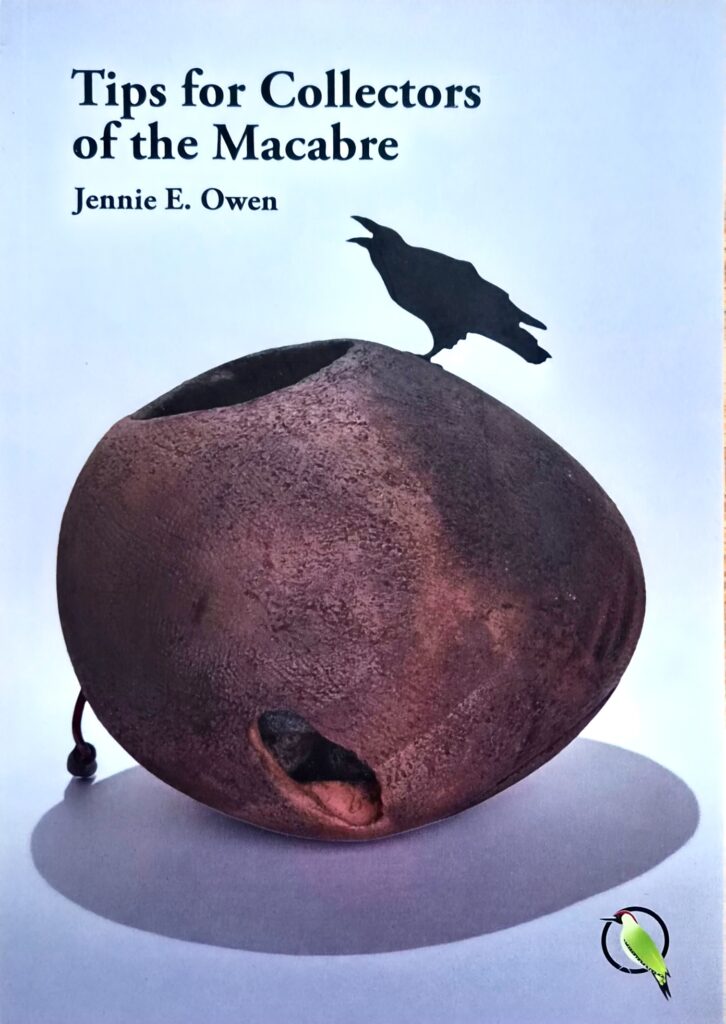
The poems in Jennie E. Owen’s The Horses Still Run (Dragon Fly Eleven, 2024) were imbued with an ambient fear – a low, persistent hum beneath the surface, an unease with a world out of step, both ecologically and socially. Fear remains central in Owen’s most recent collection, Tips for Collectors of the Macabre, but here she turns towards the shadows themselves, cataloguing the uncanny, the grotesque, and the deliciously gruesome with a sharper, more ironic edge. Pathologists, undertakers, death‑scene cleaners, and other custodians of the macabre populate these poems. Owen’s handling of the uncanny is deft, and a surprising thread of humour runs through the strangeness. The poems unsettle, but they also amuse; they lean into the grotesque without losing their sense of play. This is a collection that understands the macabre as both fascination and warning.
In ‘Washerwoman’s Hands’, inspired by J. Caruso’s academic pathologist paper ‘Decompositional changes in bodies recovered from water’ (2017), Owen shapes the poem as a kind of call‑and‑response. The lines appear in different positions on the page – staggered, indented, drifting – creating the sense of a voice murmuring its observations into a recorder. Phrases such as ‘A liquid medium’ and, offset to the right, ‘strong current’, read like the quiet notation of someone cataloguing the condition of a body, each detail arriving with clinical calm. As the poem progresses, Owen juxtaposes domestic textures – ‘wrappings / blankets curtains or sheets / clothing’ – with the more gruesome features of decay: ‘sloughing / soft tissues / blowflies / bloating / carrion beetles’. The everyday sits beside the strange and horrific, producing a visceral, uncanny eeriness that lingers long after the poem ends.
The collection is playful and immediately readable, its poems taking on a variety of shapes, forms, and lineations. Owen frequently experiments with ekphrasis, drawing on paintings, objects, and articles – Oliver Cromwell’s death mask, a mummy at the British Museum, the embalmed corpse of a baby – and her tone ranges from wistful to melancholy, ironic to irreverent. In ‘Rasputin’s penis, with Boney M‘, she riffs on the rhythm of the song, writing: ‘from Russia’s greatest lover / another shrouded artifact proved to be / 12 inches of equine phallus / (Catherine would be proud)’, a gleefully outrageous nod to the myth of Catherine the Great’s equine lover. In ‘Galileo’s finger’, most of the poem appears in a narrow column of two or three words per line until the final six lines deliver a volta; the poem’s shape resembles a hand giving the finger, and the closing lines confirm the gesture:
Although alone, detached, disjointed, knuckle high,
twisted free, and old, discarded chicken bone
your story lives on, even mouthless
you have been flipping off the Church
since the sixteenth century
(and at least you find yourself in Florence)
Similarly, in ‘Jeremy Bentham’s head’, the comic irreverence continues, and the poem’s shape becomes part of its meaning as the lines cascade down the page:
Jeremy Bentham’s head
is sat between his feet.
Not his first choice you could say,
but still,
it stops itfrom
rolling
away.
Across the collection, form is not ornament but a way of thinking: the visual architecture of each poem defines where humour, history, and the macabre collide.
Amid the playful grotesquerie, the more personal poems are its quiet gems. In ‘Cleaning up after the dead’, a poem about tending the graves of loved ones, Owen moves from description of memorial objects to an ending that catches in the throat: ‘fine rain does not offer / the glow needed. Tears are not sufficient in strength / to clean up such mess / believe me / I know’. The line lands with exhausted tenderness, admitting that grief has limits, that care cannot undo what time has already claimed. In ‘Pelt’, the smell of cold cream invokes a memory of her grandmother. She imagines in the future taking ‘Comfort in the grandchildren’, when her own cheeks will be ‘Building wrinkles of their own / with bunched fists and buttered kisses’ – a wonderfully tactile simile for crow’s feet, and one of the collection’s most affectionate images. In ‘Grandmother’, Owen reflects on inherited features and the slow fading of youth, writing of how her grandmother, watching her own youth fade and then her daughter’s, ‘watched her youth fade / and then again’, before concluding, with quiet finality, ‘when I speak it is with my mother’s tongue’. These poems reveal the emotional core beneath the macabre: the body as lineage, memory, and love.
Tips for Collectors of the Macabre feels like a conversation between the living and the dead, between the body as curiosity and the body as inheritance. Owen’s poems ask what it means to look closely at what we fear, and what tenderness might still be found in the aftermath. They do not resolve the questions they pose – how we carry our dead, how we make sense of decay – but they listen carefully to them, offering both humour and honesty. What lingers is not simply the strangeness of the macabre, but the way Owen threads it through the ordinary textures of care, memory, and family. Her work feels like an invitation: to look, to attend, to stay with what unsettles us, and to recognise the quiet human pulse beneath even the most uncanny surfaces.
Tips for Collectors of the Macabre (£14) is available from Yaffle Press
Antonia Saunders is a PhD researcher at The Open University, writing The Development of Jewish Identities in Nineteenth‑Century Histories and Novels. Her work spans Victorian and modernist literature, and she also reviews contemporary poetry and prose.