
Maybe it is happiness / mistranslated.
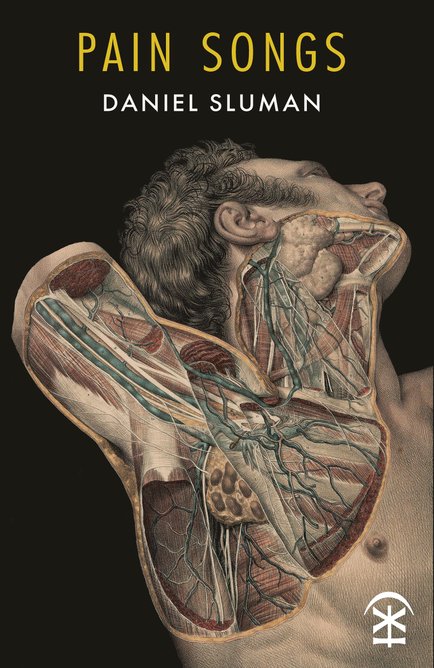
This book quietly rearranged what I thought poetry was for. What I initially mistook for simplicity in Sluman’s clear and rhythmic verse I later realised was an embodiment of endurance. Pain Songs (Nine Arches Press) is a sustained argument that care is not just a subject of a poetry book, it is a formal value that guides this and much of Sluman’s body of work.
Power of the Everyday
Sluman is already one of Britain’s most talented young poets, his amazing book Single Window – was TS Eliot shortlisted and is a must read. Single Window witnesses two vulnerable bodies in love in one room. Here, in Pain Songs, his new and fourth collection, he allows disability to become one condition through which ordinary life is experienced. Rain still falls. Lovers still argue. Food still cooks. Sex still happens. The poems resist being reduced to testimony, they insist upon the full complexity of a person’s lived experience.
Love is maintenance and attention
I am impressed that, as ever, Sluman refuses the usual disability narratives of transcendence, inspiration, sentimentalised suffering that perhaps less skilled writers might lapse into. Also for the first time in my life, I was reading his work as a person with a disability so was acutely aware of the reality of living with chronic pain. In the book I found a poetics of the everyday objects such as MRI scanners, mould, menstrual cups, parking tickets, garlic in butter, lipstick on teeth. Everything gets the same lyric attention. This is the hyper-real of constant attention to a body that is not always a safe space. Nothing is beneath the poem’s notice and that refusal to rank subject matter is the book’s real ethic.
Sluman is a craftsman and a highly disciplined poet. He chisels the subject of suffering and pain by working it into the daily negotiations of cooking, travelling, shopping, making love and trying to sleep. This refusal of melodrama makes the moments of vulnerability all the more affecting. Care appears in his poetry as small, repeated acts of witness rather than declaration or spectacle. A man washes his lovers menstrual cup, wraps rice in foil, listens for a cough, holds his baby. Love is maintenance, not idle romance.
From ‘Sustenance’:
My love language is
being survived
by the work of your hands.
Masculinity, Sex & Desire
I was utterly captivated by the theme of masculinity in these poems. Here Sluman is vulnerable without performing vulnerability and dependent without apologising for it. The poet isn’t stoic, he’s examined: washed, fed, frightened, desired. But he’s far from passive. Agency turns up regularly by naming the pain, in choosing tenderness, in imagining fatherhood. His poetry is entwined in that agency, and he gives us access to a new form of consciousness and beauty in this ‘non-traditional’ aesthetic of the body.
I loved Sluman’s delights in sexuality. The poet is a young man full of desires. His poems ‘Spit’, ‘Deserted Car Park’ and ‘Making Love for Cripples’, were some of my favourites in the collection. They don’t ask permission to be desire poems, they just are, with all the awkwardness and bodily fluids and pleasure sitting in the same register. Writing poems about sex is not easy and Sluman makes it look effortless as well as sexy. As we read, we realise his formal control, his fragmented couplets and the generous white space slows us down to extend our pleasure and asks us to stay with the attention he gives.
The Gaze, Subject, Object and Metaphor
The poem’s white space also allows our thoughts to drift and resume. Sluman often starts from an object, such as in the Hickman line where ‘a telephone installed in hope’, the MRI as ‘the open mouth / of the truth’. He lets philosophy arrive by accident and it lands; the act of living is an act of care. He is also good at symbolism. In Corpse Flower in particular, with its Baudelairean beauty-and-decay thing Sluman earns his metaphors. But he’s most powerful in the poems like ‘MRI’, ‘Hickman Line’, and ‘Rain’ where he doesn’t ask the reader for anything; he shows us the thing.
To a reader engaging in a world outside the able-bodied aesthetic, this is a rare beauty, a silver maple carries the emotional burden of chronic illness. These poems do not produce more imagery than they need. Their restraint allows the metaphor to deepen not decorate. Sluman gives us an important lesson in craft.
Pain, Care & Endurance
Despite the title I don’t think the book’s subject is Pain. The work stresses the body’s continuity. Perhaps it’s the body singing through pain. Bodies keep going. Care keeps going. By the final sequence the body produces pregnancy and life, with his approaching fatherhood suddenly I see everything reorganised as potency: the menstrual blood, the ovulation strips, the longing for children were never separate threads. I realise it was Sluman’s meditation on inheritance, all along.
The last poem lands plainly:
pain was not our God
whatever this was
it was the opposite.
There is no triumph in that line, just a new phase of the song.
How do I explain how lucky I am to be the husk this life passes through
What stayed with me as I finished the book was that attention itself starts to feel like love. Sluman looks at rain, mould, scars, the beloved’s body, with enough truth that perception and care become hard to tell apart.
Fatherhood
The collection’s emotional movement is almost invisible until suddenly it isn’t. What initially appears to be a book organised around chronic pain reveals itself to be a meditation on fertility, inheritance and continuation. I was moved by Sluman’s poems of his own father’s care, for his pending fatherhood, his tether to his partner’s fertility and to his son.
How the baby inside you sends your blood pressure vaulting and the blades of the speculum bloom open, your lashes sticky with tears, when the thin beak nicks the lip of your cervix
This is not the traditional male gaze. It is tender and potent poetry.
By the closing sequence, the earlier poems concerning blood, menstrual cycles and bodily vulnerability have quietly prepared us for a book about what survives us.
Jessica Mookherjee is a British poet of Bengali heritage. She is author of three full collections and three poetry pamphlets. She was twice highly commended for best single poem in the Forward Prize 2017 and 2021. Her second collection Tigress (Nine Arches Press) was shortlisted for the Ledbury Munte Prize in 2021. Her most recent full collection is Notes from a Shipwreck (Nine Arches Press 2022). In 2023 she also published a long London prose poem Desire Lines – with Broken Sleep Books. She is a tutor for Arvon.
Pain Songs by Daniel Sluman is published by Nine Arches Press (2026): ninearchespress.com