
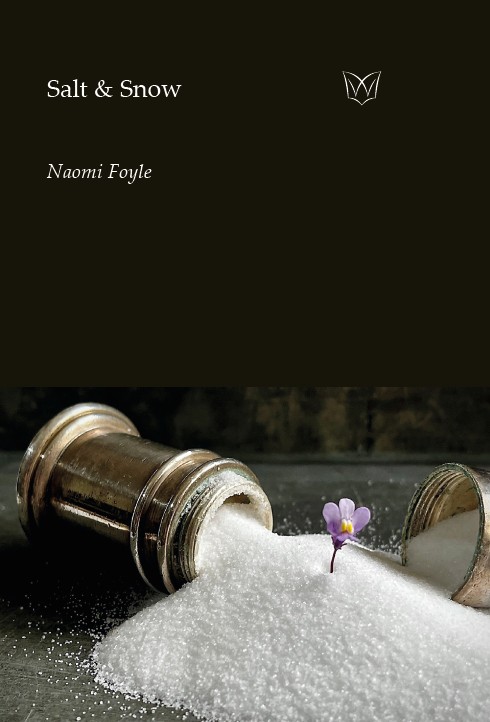
An opening poem often acts as an overture for a collection and Naomi Foyle’s prelude poem (and title poem) ‘Salt & Snow’ is no exception; it appears as a kind of broken sonnet that illustrates the rupture that the poem’s speaker feels at the death of someone beloved (one of the main themes is loss, a refrain of the collection). In this poem, even the gardening shears are too much to hold, given their capacity to sever things still living; the mere possibility of severance is enough. While there’s plenty of things living and thriving in these poems, at the same time, things are at a tilt in many of them and in this first severed sonnet things are ‘scorched’, ‘freakish’, ‘struggling’, ‘stifled’, ‘wilting’, ‘uprooting’ and the person who has gone, is released ‘to the air’.
Indeed, wrenching loss marks the first half of this reflective, eloquent and meditative collection, the first section ‘Out of Season’ is made up of fourteen poems, each with a dedication to a no-longer-living friend, including the poets Judith Kazantkis, Lee Harwood as well as to Sylvia Plath. But if these are the Salt of the title (preserving as it does), Snow is not a move away from difficulty, but to different and in someways connected terrain, as salt and snow are in reality.
The ‘snow’ poems still reflect pain, but this is more external, less intimate, though no less strongly felt. Foyle does not shy away from naming war crimes, from the damage racism and colonialism causes, from governments that allow LGBT persecution (‘The Dark Earth’) and even a clever villanelle on the hypocrisy, ruthlessness as well as personal impact of ‘Organisational Change’ in the contemporary workplace; in this case the impact on teachers who strive to do their best for years and are simply disposed of by a market-led, hierarchical educational system.
But I don’t want to paint a picture of a morose or gloomy series of poems, far from it; where there is fury there is an energy; one which does not equate to despair. And there are affirmations too (‘this is how I now aspire/ to fail to fish, to sift for fire’) despite many absences and deeply felt moments of pain as evoked in the suffering of George Floyd, Shani Louk (‘Supernova’), all the civilians wounded and killed in Beirut and in Gaza. Foyle reminds us, when we meet above the abyss, ‘we must look not down/ but at each other’ (‘Striver’). Affinities (family, love, friends, faith), despite the shears that would sever, is what binds us, as disparate as we are, and this collection succeeds in reminding us that all we have is each other and that language connects us, as these poems do.
Salt and Snow is published by Waterloo Press (2025).
Andrea Holland teaches Creative Writing at UEA and is the author of two collections of poetry, Broadcasting, which won the Norfolk Commission for Poetry and Borrowed, a finalist in The Poetry Business Book & Pamphlet Competition. Individual poems appear in journals and anthologies, including The World Speaking Back: poems for Denise Riley, and in 2021 she had a poem nominated for the Pushcart Prize. She is a contributor to The Portable Poetry Workshop (Palgrave/Macmillan) and has published several articles on poetry, writing and collaboration. Her new collection, High Wire is forthcoming from Story Machine/Gatehouse Press.