
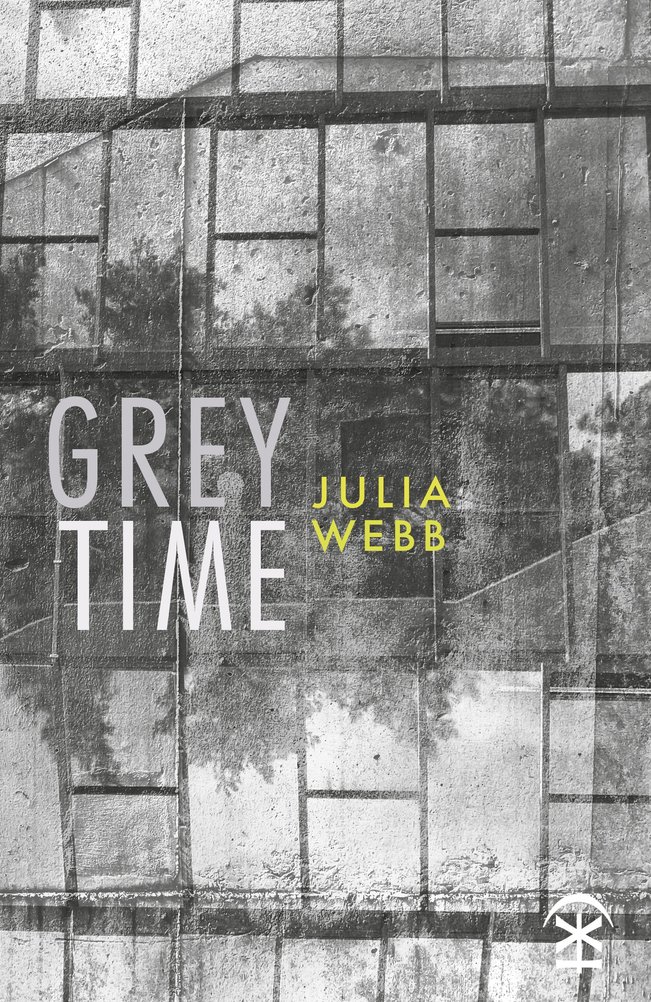
Julia Webb’s Grey Time, her fourth collection with Nine Arches Press, insists on the full weather of grief. It refuses consolation or tidy acceptance, tracing the recursive ways mourning inhabits a life — memory, dream, body, animal.
From the opening pages, Webb stages grief as ritual and repetition. Each day the speaker climbs the exposed tower of loss, pausing for breath at the midway point, aware of the groove grief has carved — and of the dangerous wish to dismantle it altogether.
The shape of grief
Grief in Grey Time becomes architecture, map, creature, weather. In “A Geography of the Dead,” burial grounds sit close to the roar of traffic: mourning unfolds while the world goes on. In “The Hare,” the totem animal becomes omen, memory, guilt — never explained, allowed to remain strange. These are metaphors that work, not decorate.
The title poem, “Grey Time,” is the collection’s hard core. Hospitals, buffets, paperwork, piss-stained sheets, refrigerated lorries: Webb resists elegiac polish, holding love, irritation, exhaustion and tenderness together in a finely shaped prose sequence. Its moral clarity lies in refusing to simplify.
Mother as enchanted wound
Webb’s portraits of the mother are complex and heartbreaking. “For I Will Consider My Mother” praises — Who stained the world purple and covered it with glitter — enlarging her into myth. Elsewhere the mother is enmeshing, consuming. In “The Same Mother,” the daughter is taught to be a house, not a tree, while the roots spread deeper into your foundations. Love and constraint are inseparable.
Elegy does not erase harm. Webb honours that contradiction.
Childhood, trauma & ghosts
Some of the most affecting poems return to childhood with devastating simplicity. In “A Small Girl Cries on a Blue and Black Tiled Kitchen Floor,” snow fills the kitchen until the mother disappears. It doesn’t describe trauma; it enacts it. “Trying to Make Sense of Things” watches a child find unconditional love only to lose it, perhaps still in the hallway waiting.
Ghosts recur as psychic residue. “The Magic Ritual” confronts survivorhood: the speaker, stunned by morning news, walks as though partly dead.
The quieter violences
Webb makes visible harms that leave no bruises. In “If Only You Didn’t Have to Shove Your Living in My Face,” the beloved wants the speaker smaller, quieter. She folds herself into corners until even her shadow is too much — and then breath becomes resistance: I sucked in as much air as I could.
Mothering as a different animal
Turning to her own motherhood, the register shifts — not to sentimentality but to a new animal knowledge. “More bird than woman,” she listens, learns the child’s weather, offers him the cosmos and then relinquishes it. A kind of repair, without pretending redemption.
The relentlessness of grief
Losses keep arriving. In “After My Brother Died, I Let My Garden Get Overgrown,” guilt and beauty coexist: tears, sunlight, an unruly garden. In “If,” syntax fractures into the grammar of regret — if I wasn’t / I would’ve fought — until language meets the blunt fact of the headstone. Grief has seasons — and they return.
The owl in the dark
The closing poem, “Without,” is an unguarded act of making. I am building you an owl, the speaker writes — waiting for your breath to knock it down. After, the wish — I wish you back from the dead — comes a gentler gift: acres of owl flight… the smells of the woods. Darkness becomes path, knowledge, companionship.
Where much British writing about mourning leans to restraint, Grey Time risks imaginative ferocity. It is unsentimental and deeply humane: a book that understands how love and damage endure together, and how language, even when it fails, may be all that remains.
Grey Time does not console. It stays. And that feels like truth.
Jessica Mookherjee is a British poet of Bengali heritage. She is author of three full collections and three poetry pamphlets. She was twice highly commended for best single poem in the Forward Prize 2017 and 2021. Her second collection Tigress (Nine Arches Press) was shortlisted for the Ledbury Munte Prize in 2021. Her most recent full collection is Notes from a Shipwreck (Nine Arches Press 2022). In 2023 she also published a long London prose poem Desire Lines – with Broken Sleep Books. She is a tutor for Arvon.
Grey Time by Julia Webb is published by Nine Arches Press (2025): ninearchespress.com